By David Solomon
Over the past several years, school leaders have focused intensely on learning recovery, student engagement, and inclusive instruction. But amid conversations about AI, tutoring, and mental health supports, one foundational issue continues to receive far less attention than it deserves: whether students can clearly hear and process instruction in the classroom.
That challenge is becoming increasingly important in today’s learning environments. Modern classrooms are collaborative, active, and often noisy. Teachers are balancing small-group instruction, multilingual learners, neurodiverse students, and inclusive classroom models designed to serve a broad range of learning needs simultaneously. In that environment, access to instruction is not just about curriculum or devices. It is also about communication.
Education leaders across the country are beginning to recognize that classroom audio clarity has a direct impact on student engagement, comprehension, participation, and confidence. For many students, the ability to clearly hear instruction can shape whether they remain connected to learning throughout the school day.
This conversation aligns closely with broader national trends around educational equity and Universal Design for Learning (UDL). Increasingly, districts are moving away from reactive accommodations and toward proactive learning environments that support all students from the start. Classroom audio is emerging as one piece of that larger accessibility strategy.
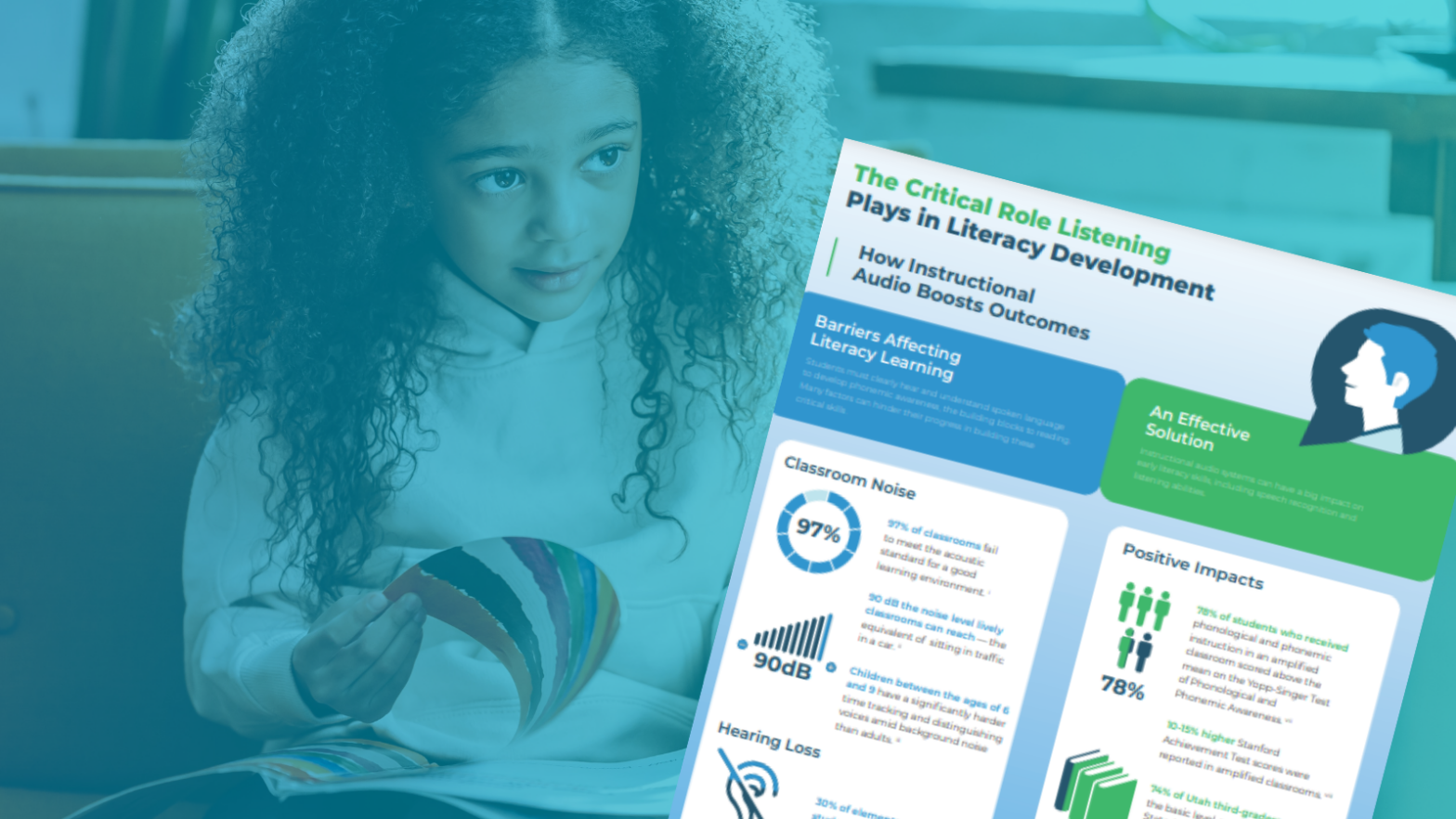
Research has long shown that classroom acoustics affect student comprehension, particularly for younger learners whose auditory processing skills are still developing. But the issue extends well beyond students with diagnosed hearing challenges. Background noise, poor acoustics, hallway disruptions, HVAC systems, and large classroom layouts can all interfere with speech clarity.
Students who are multilingual learners, neurodiverse, or experiencing attention and processing challenges may be especially affected. Even students without formal learning differences can struggle to maintain focus when they consistently miss portions of instruction throughout the day.
Those missed moments add up.
Teachers often notice the effects in subtle ways first. Students ask for repeated directions. Participation drops. Some learners become hesitant to contribute because they are unsure if they understood what was said. Others disengage altogether after repeated frustration trying to follow instruction in noisy environments.
As schools continue addressing unfinished learning and chronic absenteeism, many educators are taking a closer look at the physical learning environment itself. Classroom design, sensory supports, flexible seating, and student wellness initiatives are all receiving increased attention. Audio accessibility increasingly belongs within that same conversation.
The goal is not simply making the teacher’s voice louder. It is creating consistent speech clarity so every student can access instruction regardless of where they sit in the room.
This is particularly relevant as inclusive classroom models continue to expand nationwide. More schools are educating students with varying academic, language, sensory, and learning needs together in general education settings. In those environments, equitable participation depends heavily on whether students can reliably hear and process classroom communication.
The conversation around accessibility is also evolving beyond compliance and accommodations. Increasingly, educators are viewing inclusion through the lens of belonging. Students who can fully engage in classroom discussions, collaborate with peers, and confidently follow instruction are more likely to feel connected to the learning experience itself.
Clear communication supports that sense of belonging. At the same time, districts are grappling with another major national issue: teacher burnout. Teacher retention remains one of the most urgent challenges facing K–12 education, and classroom voice strain is an often-overlooked contributor. Educators spend hours each day projecting their voices across active classrooms while repeating directions, redirecting students, and managing transitions.
Many teachers report chronic vocal fatigue and exhaustion, especially in elementary and collaborative learning environments. As schools search for practical ways to improve teacher working conditions, reducing daily communication strain is becoming part of broader wellness and retention conversations.
Importantly, classroom communication is not only about the teacher’s voice. Student voice matters as well.
Collaborative learning and peer discussion have become central to modern instructional practices, but they can unintentionally create participation barriers for quieter students or those with speech, hearing, or confidence challenges. When students cannot clearly hear one another, discussion quality and engagement can suffer.
Creating environments where every student can contribute and be heard supports not only academic outcomes, but classroom culture overall.
None of this suggests that technology alone creates inclusive classrooms. Strong relationships, effective instruction, and supportive school cultures remain the foundation of student success. But the physical environment can either reinforce or undermine those efforts.
As districts continue investing in equity initiatives, student engagement strategies, and inclusive instructional models, classroom communication is becoming harder to ignore as a foundational part of learning access.
The reality is straightforward: students cannot fully engage with instruction they struggle to hear.
As schools rethink what equitable instruction looks like in modern classrooms, accessibility is increasingly being understood not only as a curriculum issue, but as an environmental one. Classroom acoustics, communication clarity, and student participation are becoming part of a larger conversation about how schools create learning spaces where every student can succeed.
About the Author
David Solomon is CEO of Lightspeed Technologies, a company focused on instructional audio solutions that support equitable learning environments in K–12 classrooms.