Tell us about your company and the problem it solves, or its benefit to learners or educators.
At Lightspeed Technologies, our focus is creating better environments for learners by addressing something that is fundamental to instruction but often overlooked: the listening environment.
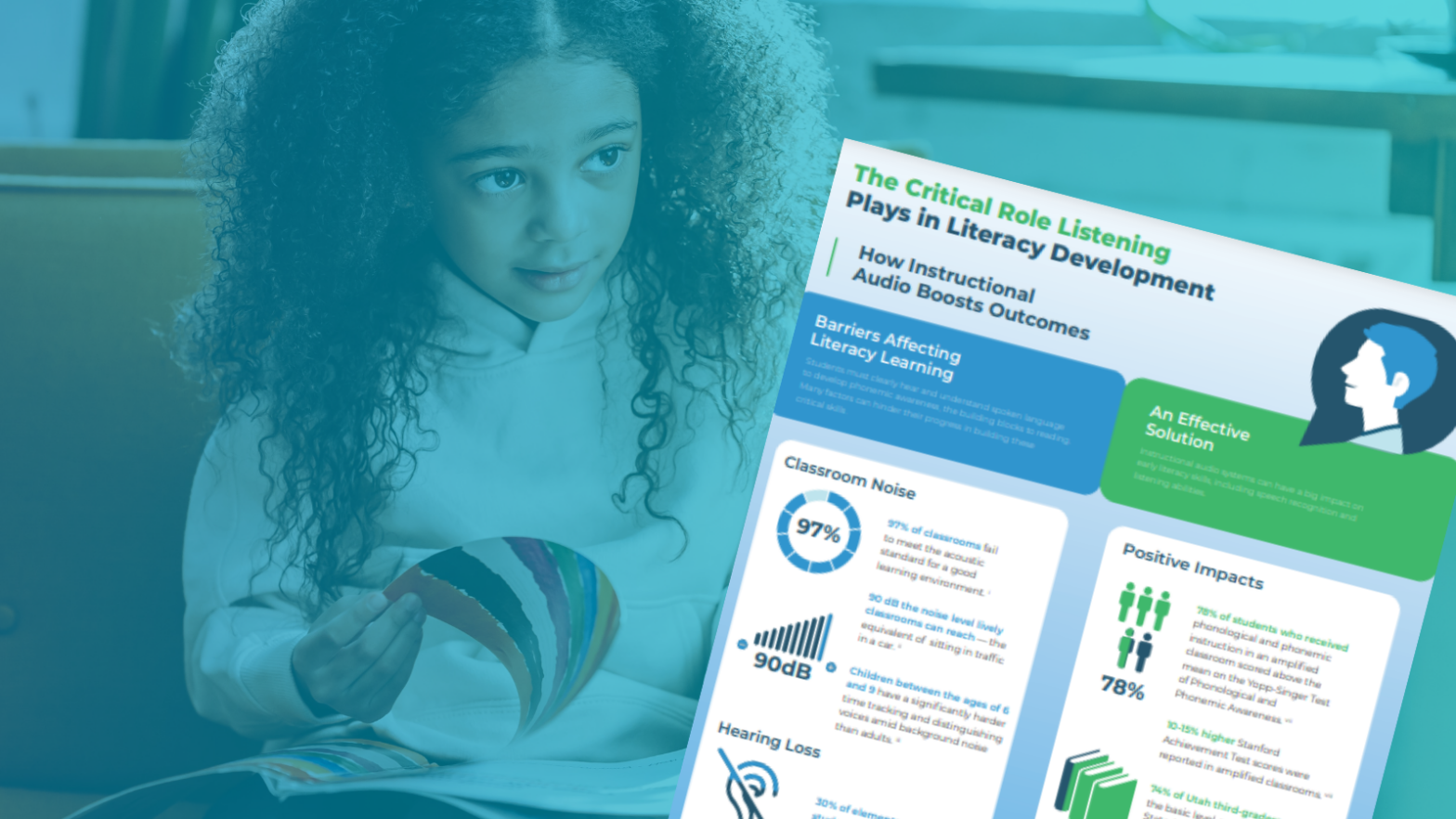
A classroom is a surprisingly difficult place to hear. Students come into the classroom with a wide range of developmental differences, attention challenges and, in some cases, mild hearing loss that may not yet have been identified. Younger students in particular are still developing their ability to prioritize what they hear. Add HVAC systems, computers, movement and conversations, and the listening environment becomes even more complex. When the teacher’s voice has to compete with everything else in the room, students expend cognitive energy simply trying to understand what was said rather than focusing that energy on learning.
Our instructional audio systems provide highly intelligible sound at a comfortable volume throughout the classroom, so students can hear the teacher clearly regardless of where either of them is in the room. Just as importantly, teachers don’t have to project their voices all day to make that happen.
What I find particularly powerful about this technology is its simplicity. It doesn’t require teachers to add another application, change their curriculum or create another task in their day. Once it is in place, it simply improves the environment in which teaching and learning are already happening.
And there is a larger benefit that I think matters increasingly in education: human connection. Our technology only has value when people are interacting. It helps teachers and students hear one another, participate and communicate more effectively. At a time when so much of our lives is mediated through screens, creating better conditions for meaningful human interaction in the classroom is something worth protecting.
What is the challenge educators face today that is fixable?
One challenge we can address right now is making the classroom environment work better for both teachers and students.
Teachers have an enormous amount to accomplish during a school day, and time is one resource we cannot give them more of. But we can reduce some of the friction that consumes that time. When students miss directions, struggle to distinguish the teacher’s voice from competing noise or lose focus because listening itself requires too much effort, instruction slows down. Teachers repeat themselves, students interrupt for clarification, and transitions take longer.
We can improve those conditions.
A strong listening environment allows instruction to move more efficiently because students can hear and process what is being said the first time. It can support better participation and focus while helping create a calmer classroom environment. A vibrant classroom should have conversation and activity; the goal isn’t silence. The goal is making sure the most important communication is clear.
There is also a teacher well-being component that deserves more attention. For generations, teachers have relied on the “teacher voice”—projecting loudly enough to reach every corner of the room. Doing that for hours every day is physically demanding and can contribute to vocal fatigue and other voice problems. When teachers can speak naturally and still be heard throughout the classroom, they can preserve energy for the work that matters most: teaching, responding to students and building relationships.
We cannot eliminate every challenge educators face. But we can remove unnecessary barriers that make teaching and learning harder than they need to be.
What is the challenge educators face today that will persist?
I think the persistent challenge will be making good decisions amid competing demands and finite resources.
Funding is certainly part of that. District leaders are operating with significant uncertainty about what resources they will have and what may disappear. At the same time, enrollment patterns are changing in many communities. When students leave a district for another educational option, funding may follow them, but many of the district’s fixed costs remain. The buildings, buses and other infrastructure don’t shrink at the same rate as enrollment. That creates difficult choices about where limited dollars can have the greatest impact.
But funding is only one piece. Schools are balancing academic priorities, technology investments, student behavior and engagement, changing expectations from families, and pressures coming from local, state and federal levels. There is rarely one problem to solve in isolation.
One change I view positively is greater family involvement in education. The last several years gave many parents a much closer view into how their children learn, and that changed the relationship between families and schools. Rebuilding trust where it has been strained will take time, but I hope we don’t lose that engagement. Ultimately, students benefit when families understand and participate in their education.
For education leaders, the enduring challenge will be determining what deserves their attention and investment. That makes it increasingly important to look beyond what is newest or most visible and ask a more fundamental question: What will meaningfully improve the experience of teachers and students, and will that value endure?
What are the areas of education or training and workforce development that are being overlooked?
We need to think much more intentionally about preparing students not simply to consume emerging technologies, but to apply them.
Artificial intelligence is an obvious example. There is tremendous interest in putting AI tools in front of students and determining how they can be used for schoolwork. Those are important conversations, but they are different from teaching students how these technologies work, how they can be implemented and how they can be used to solve real problems.
That distinction matters because the workforce students are entering is changing rapidly. A student who develops meaningful expertise in AI, computer science, engineering or another emerging field may be able to move directly from high school or a targeted postsecondary program into work that once required a much more traditional pathway.
I also think we could do a better job connecting education to workforce opportunities that already exist within communities. There may be an exceptional physics, engineering or technical program operating in a high school without nearby employers even knowing that a talent pipeline exists. Technology gives us an opportunity to identify those pockets of strength and connect them more deliberately with employers, higher education and public investment.
Historically, there have been moments when the country made very intentional investments in developing scientific and technical talent because we recognized it as a national priority. We need some of that same intentionality now.
The question shouldn’t only be, “Are students using the newest technology?” It should be, “Are we giving students the knowledge and skills to do something meaningful with it?” That shift—from consumer to creator and implementer—could open entirely new pathways for students while helping communities develop the workforce they will need. If we can connect those skills more intentionally to emerging industries and local workforce needs, we can give students a clearer line of sight between what they are learning today and the opportunities available to them tomorrow. That benefits more than the individual student. It gives employers access to talent, helps communities retain young people and creates a stronger connection between education and economic opportunity.
What do you foresee will be a challenge in education in three to five years?
Education will have to prepare students for a working world defined by far more flexibility than previous generations experienced.
The traditional idea that you prepare for a profession, enter a company, perform essentially the same kind of work and build a career along a predictable path is already changing. Artificial intelligence will accelerate that. Organizations will become more fluid, job responsibilities will evolve more quickly, and people may move among roles and even disciplines while remaining with the same organization.
That means adaptability itself becomes a critical life skill.
I’m not sure our education system has fully absorbed that shift yet. We understandably focus on preparing students to master particular bodies of knowledge and develop specific skills. Those remain essential. But students will also need to know how to learn continuously, apply their knowledge in unfamiliar situations, work with emerging technologies and adapt when the job they were originally trained to do changes.
The challenge for schools is that they are preparing students for careers that may evolve dramatically before those students are even established in the workforce. We cannot predict every job AI will change or every new role it will create. What we can do is give students strong foundational knowledge, technical fluency, problem-solving skills and the confidence to keep learning.
And as technology becomes more capable, I think human skills become more—not less—important. Communication, collaboration, judgment and the ability to build relationships will remain extraordinarily valuable. That belief is also central to how we think about technology at Lightspeed. The best technology shouldn’t diminish human interaction; it should create better conditions for it. Technology should help people work and learn together more effectively rather than isolate them from one another.
The future will demand flexibility, but our goal shouldn’t simply be to help students keep up with change. It should be to prepare them to participate in shaping what comes next.
David Solomon is CEO of Lightspeed Technologies, where he has spent the past 18 years helping lead the company’s growth and evolution. During his tenure, he has served in multiple leadership roles, including VP of Marketing and SVP of Sales and Marketing, before assuming his current role as CEO. Lightspeed is a leading developer of instructional audio solutions for K–12 education, helping create classroom environments where every student can hear clearly and every teacher can be heard.